
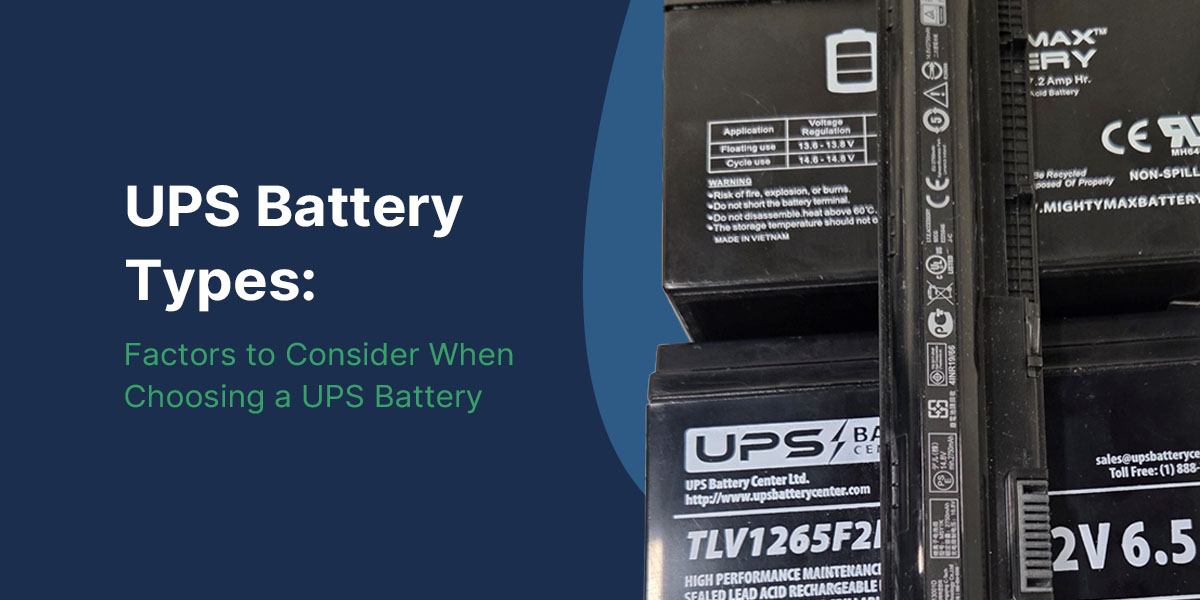
In today’s demanding business landscape, companies need dependable uninterruptible power supply (UPS) systems to help prevent data loss, IT equipment damage and downtime during critical power emergencies. At the core of every reliable UPS system are its batteries.
Not all UPSs can use all the batteries discussed, so the UPS specifications should be verified, prior to purchase. It should also be noted that changing configurations from manufacturer-tested configurations can void UL certifications.
The 3 Main UPS Battery Types
The market offers different types of UPS batteries with varying costs, service life and maintenance needs. IT managers can choose from these three primary types of UPS batteries:
1. Lead-Acid Batteries
Lead-acid batteries are commonly used for UPS systems because of their durability and cost efficiency. They deliver reliable backup power, particularly in high-load settings. However, they tend to be heavier than other UPS batteries. Some lead-acid batteries are known to reduce impedance, which is a battery’s resistance to the flow of electricity. In general, lower impedance allows electricity to flow more easily.
Below are the two main types of lead-acid batteries:
- Valve-regulated lead-acid (VRLA): These sealed UPS battery units require minimal maintenance and can be installed in horizontal or vertical positions. VRLA batteries come in two types — absorbed glass mat (AGM) and gel-type VRLA, which differ in how their electrolyte is contained. AGM batteries use a porous glass mat to absorb the electrolyte, while gel batteries use a silica-based gel. AGM is generally preferred for UPS applications due to its lower cost, low impedance and ability to handle higher charge and discharge rates. However, gel batteries offer a wider operating temperature range and a potentially longer design life
- Flooded lead-acid: Also known as vented batteries, flooded lead-acid batteries contain electrolyte acid. They require regular maintenance, including water refilling and ventilation. While they have higher impedance than AGM types, they offer robust cycle life and stable long-term performance. Their simple design makes them a cost-effective option for stationary setups, but they require specific safety measures, such as a dedicated battery room with proper ventilation and wash-down facilities.
2. Nickel-Cadmium Batteries
Nickel-cadmium batteries are highly tolerant of deep discharges, have a long lifespan and can operate in a wide range of temperatures. However, they are more expensive than VRLA batteries.
When selecting a battery for your UPS, it’s important to consider that toxic materials like nickel and cadmium raise safety concerns and increase the cost of disposal or recycling. Despite these drawbacks, nickel-cadmium batteries are a good solution for UPS applications in high-temperature environments.
To ensure proper sizing and handling of nickel-cadmium batteries, the Institute of Electrical and Electronics Engineers (IEEE) has established IEEE 1115, a set of recommended practices specifically for these batteries.
3. Lithium-Ion Batteries
Commonly found in electronic devices, lithium-ion batteries are increasingly used in UPS systems. They stand out from VRLA and nickel-cadmium batteries due to their integrated monitoring capability, enabling IT professionals to check individual battery cells and track performance.
Lithium-ion batteries are lightweight and smaller, with longer service life and faster charging than VRLA. While the initial cost is higher, the extended service life, reduced cooling needs and lower maintenance can balance the overall cost.
Factors to Consider in Choosing the Right UPS Battery Unit
Selecting the ideal UPS battery involves more than assessing the cost and battery type. Before choosing and installing any type of battery local city and fire codes/statutes should be reviewed. Review these factors to maximize UPS battery performance and reliability:

1. Know the Service Life of the Battery
While often used interchangeably, battery design life and service life are different concepts. Design life is determined by manufacturers under controlled lab conditions, rarely replicating real-world performance. In contrast, service life accounts for the impact of the application, installation, operating conditions and maintenance practices on the battery’s aging. Service life provides a more realistic expectation of battery performance.
Many factors affect the service life of UPS batteries, including the temperature and humidity of the operating environment and storage conditions. For example, high temperatures can degrade battery performance faster.
To maximize battery performance, keep UPS systems in temperature-controlled, clean areas. IT managers should also prioritize regular and thorough battery maintenance to prevent decreased performance and premature battery failure.
2. Check the UPS Battery String Configuration
UPS battery systems use various string configurations to achieve different levels of reliability. The simplest is a single battery string, suitable for smaller applications but offering the least resilience due to a single point of failure.
Parallel battery strings enhance power capacity and resilience while reducing downtime. However, they require a higher initial investment. For mission-critical systems, redundant battery configurations provide the highest reliability with an additional string for backup.
The choice extends to whether parallel UPS systems use a common or separate battery arrangement. A common battery configuration shares a single battery bank, while a separate configuration dedicates a battery unit to each UPS. As each approach presents trade-offs between cost, space and battery resilience, determine which factors to prioritize for your specifications.
3. Understand UPS Battery Maintenance Requirements
Routine maintenance helps ensure reliable UPS battery power. Depending on the battery type, it will have specific maintenance needs. For example, lithium-ion batteries are generally not as high-maintenance as flooded lead-acid batteries, which require more frequent attention. Consider using UPS battery monitoring systems to proactively address battery conditions, as they detect weak cells before they lead to system failures.
Battery maintenance is also crucial for maintaining warranty validity and meeting regulatory requirements set by the IEEE. IEEE standards offer recommended practices for UPS battery maintenance, testing and replacement, outlining the necessary steps to assess the condition of different battery types. For example, you can review IEEE 1188 for VRLA UPS battery maintenance recommendations. Adhering to these guidelines is key to maximizing battery lifespan and performance. Battery manufacturers also have requirements to maintain the warranty over their lifespan of the batteries.

Contact Unified Power for Reliable UPS Battery Solutions and Services
From small businesses to large industrial operations and sensitive data centers, ensuring continuous power supply uptime is essential to minimize revenue loss. If you’re an IT professional or business owner, understanding the nuances of UPS batteries empowers you to choose the most suitable battery solutions for your applications. For all your UPS battery service needs, turn to Unified Power. We provide comprehensive UPS equipment and battery solutions, including dependable UPS battery replacement, UPS battery maintenance services, battery capacity testing and battery monitoring services with daily reports.
For over two decades, Unified Power has been the trusted expert in critical power services for companies across the US. We also have the largest nationwide footprint of UPS technicians. To get you started, we offer a variety of UPS maintenance service plans tailored to suit your unique requirements. You can also trust us with commercial generator repair and maintenance services.
Contact us online today to request a quote and to schedule your next comprehensive UPS battery maintenance service.